|
15 Leland Ave.
P.O. Box 578
Schroon Lake, New York 12870
Phone #518-532-7737 Fax #518-532-9474 Office Hours 8am - 4 pm
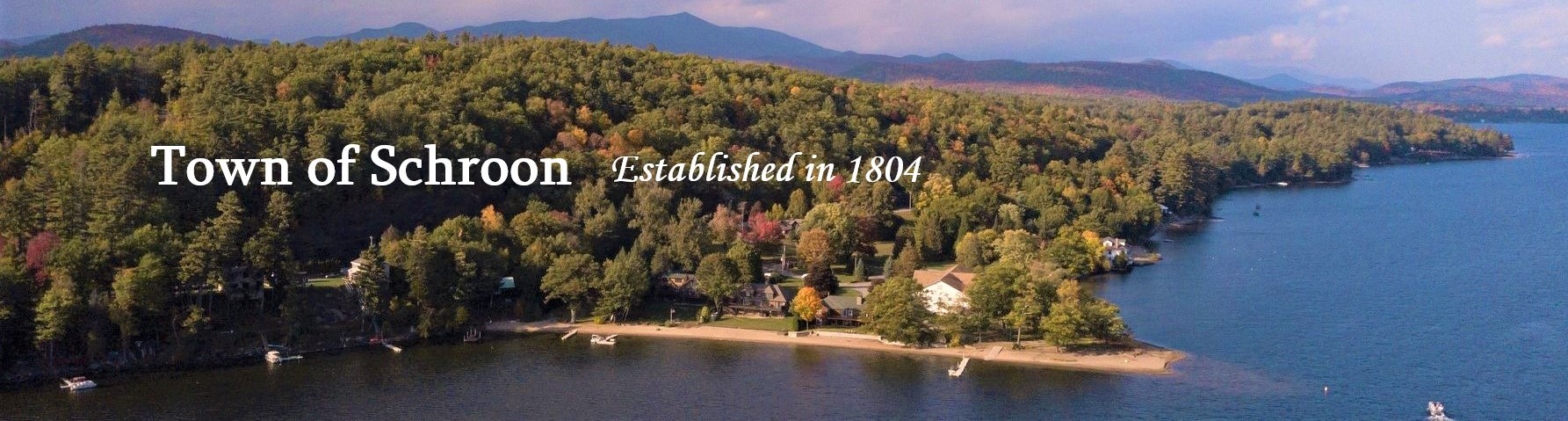
Welcome to the Town of Schroon
website. We would like to introduce you to the Town of Schroon, a quaint hamlet
in the heart of the Adirondacks, Essex County, in upstate New York. Your
very first stop in our Town should be at our Chamber of Commerce Office on Main
Street so that you may pick up our 2009 brochure, along with many other
brochures, to see all that we have to offer. Our aim is to please you, and
we sincerely hope that after visiting our website you will consider
Schroon Lake as a future vacation destination, future home, or possibly as
the home for your business.
Cathy Moses Supervisor
E-MAIL ADDRESSES
Mike Marnell Town Supervisor
marnell@schroon.net
Roger Friedman Town Councilman
roger@friedmanrealty.net
Meg Wood Town Councilwoman
megcarrwood@gmail.com
Clara Phibbs Town Councilwoman
N/A
Donald Sage Town Councilman
cpt00089@wildmoo.net
Patricia Savarie Town Clerk
psavarie@schroon.net
*********************************************************************************************
2011
TENTATIVE ASSESSMENTS
********************************************************************************
UPCOMING MEETINGS
All meetings held in Town Hall meeting room unless noted otherwise.
*********************************************************
NEW TIME FOR
TOWN OF SCHROON
REGULAR TOWN
BOARD MEETINGS
6 PM THE SECOND MONDAY OF EACH MONTH UNLESS OTHERWISE
NOTED
*****************************************************************************
TOWN OF
SCHROON
ORGANIZATIONAL
MEETING
January 3,
2012 – 6 PM
AGENDA
-
PLEDGE TO THE FLAG
-
PUBLIC PARTICIPATION
-
MINUTES
-
BILLS
-
RESOLUTIONS
-
Day and time of the monthly
Town Board meeting shall be the second Monday of each month at 6 PM unless
otherwise advertised.
-
Legal Newspaper - Times of
Ti, Daily Glens Falls Post Star & Press Republican
-
Official Depository - Glens
Falls National Bank & any other NYS bank for investments
-
Sewer and Water Tax Collector
– Patty Savarie
-
Auto expenses for Town
employees $.445 per mile
-
Budget Officer – Chris Stone
-
Health Officer-HHHN-Hourly as
needed – MD not required
-
Register of Vital Statistics
– Patty Savarie - Deputies – Betsy Calhoun & Denise Paradis
-
Deputy Clerk of conservation
licenses – Betsy Calhoun & Denise Paradis
-
Maximum of $1000 for small
tools and implements for Highway Department without prior Town Board approval
-
Legal Holidays for Town
employees - New Years Day, Martin Luther King Jr. Day, Presidents’ Day, Good
Friday*, Memorial Day, Independence Day, Labor Day, Columbus Day, General
Election Day, Veteran’s Day, Thanksgiving Day and Friday after, and Christmas
Day (Day after only if it falls on a scheduled workday. (*Transfer Station
employees will observe Easter Sunday as a holiday in lieu of the Good Friday
holiday)
-
Deputy Supervisor - Roger
Friedman $1000/Ann.
-
Deputy Highway Superintendent
– Roger Mahler - $1500/Ann.
-
Secretary to the
Supervisor-$14.72 per hr.
-
Salaries of elected officials
as budgeted and advertised
-
Salaries for HEO’s: Roger
Mahler and Charles Hall - $17.82 per hr.; Don Fish - $13.73 per hr.; Gordon
Graves - $17.13 per hr.; Richard McCray - $13.73 per hr.; Paul Bessey - $15.69
per hr.; and Wayne Welch - $13.73/Hr. MEO's: Brian McCoy - $12.26; Nathan
Armstrong - $12.26 per hr.; Lance Gould - $17.13 per hr.; LABORERS as follows:
Chris Savarie & Joe Flores - $9.78 per hr.
-
Department head salaries per
budget – Water & Sewer
-
Town Clerk hours - 10AM to 12
N - 1PM to 3PM – Mon - Fri
-
Public Information Officer -
Town Clerk
-
Chairman of Board of
Assessors – Richard Schoenstadt
-
Chairman of Planning Board –
-
Chairman of Zoning Board of
Appeals – Robert Claus – Temporary Chair
-
Set Hourly Rate for Board of
Assessment Review - $10.00 per hr. and mileage $.445
-
Chairman of Youth Commission
- $2000/Ann.
-
Appoint Tina Armstrong Youth
Coordinator - $1500/Ann.
-
Town Attorney to be retained
as needed - Cherie Indelicato
-
Renew contract with Senior
Citizens - $13,150 Rec. & Soc. Program
-
Dog Warden - $800 plus $.445
per mile – Laurie Bruce
-
School Crossing Guard –
Mallory Moses - $8.73 per hr.
-
Building Inspector III – Jon
Senecal
-
Approval of Chamber of
Commerce Contract as budgeted - $18,000
-
Approval of Ambulance
Contract-$45,000
-
Re-appointments to Revolving
Loan Fund Committee – Georgia Burnhardt – 12-31-13; Doug Mieras – 12-31-13;
Roger Sachleben – 12-31-13 and Mary Egan, Alternate – 12-31-13
-
Re-appointments to SL Park
District Commissioners – Vacant and Edward Donley (Alternate) - 12-31-13
-
Approve attendance to
Association of Towns Annual meeting in February with all actual and necessary
expenditures being paid by the town. Voting delegate for Assn. of Towns
Meeting – Roger Friedman – Alternate -
-
Resolution to use short form
for advertising of Annual Report of fiscal affairs of the Town of Schroon
-
Town Historian – Gary Glebus
- $600
-
Resolution to pay bills to
date and to pay utility bills when received during 2012
-
Petty cash fund for Town
Justice - $200, for Town Clerk - $50
-
Renew Dog Control Contract
with Dr. Mack
-
Accept Annual Historian
Report
-
Accept Annual Justice Report
-
Accept Golf Course Annual
Report
-
Accept Animal Control
Officers’ Report
-
Set copy fees at $.25 for
first 10, then $.10 per copy
-
Set fax fees - $.25 incoming
- $5.00 out-going
-
Accept Zoning/Septic/Bldg.
codes report form Codes Enforcement Officer, Don Sage
-
Renew agreement with Water
Meter - Will now be done by Water/Sewer Assistant Operator
-
Appoint Parade Chairperson –
Kate Huston
-
Continue Schroon Lake Water
Quality Study with Adirondack Ecologist per budget
-
Review Procurement Manual
-
Annual Accounting – Any
Department collecting monies
-
Renew County & State Highway
Work Permit
-
Approval of the Highway
Superintendent’s attendance to the Annual Highway School including the payment
of necessary expenditures
-
Appointment of committees for
2013 – Discussion
-
Request to attend Golf Course
Training – Tabled
-
Accept Golf Course Report –
Tabled
-
Request from all departments
a list of surplus, if any, equipment with a minimum bid – sold to highest
bidder
-
Winter rental at Airport
-
Cemeteries – Protestant,
Catholic, Severance - $400 for cemetery maintenance
-
Renew oil separator contract
for Highway Garage floor drain system
****************************************************
NEW
HOURS
FOR
TOWN OF SCHROON
TOWN
CLERK
EFFECTIVE JANUARY 1, 2012
OPEN
THROUGH LUNCH
MONDAY – FRIDAY
10:00 A.M. – 2:00 P.M.
OR
BY APPOINTMENT BY CALLING
532-7737 X12
*******************************************************************************************
TO REPORT STREETLIGHT
OUTAGES:
Call Town Hall - Chris
Stone - 532-7737 Ext. 10 with Pole Number & Location
PUBLIC NOTICE
BRUSH UP TO SIX INCHES IN
DIAMETER IS CURRENTLY BEING ACCEPTED AT THE SCHROON LAKE TRANSFER STATION.
PUBLIC NOTICE
PLEASE NOTE THAT PLANS 2A & 2B FOR THE PHASE II WASTEWATER PROJECT ARE AT
THE TOWN CLERK'S OFFICE FOR PUBLIC REVIEW.
PUBLIC NOTICE
NEW GRANT OPPORTUNITIES FOR NOT-FOR-PROFITS
Community Fund for the Gore Mountain Region
Affiliated with the Adirondack Community Trust
Applications are available with the Town Clerk at Town
Hall - 518-532-7737 Ext 12
***************************************************************************************************
TOWN OF SCHROON
Annual Drinking Water Quality Report for
2010 - SEE BELOW
SWINE FLU FACTS
PROPOSED ADDITION TO TOWN HALL - EXTERIOR
VIEW
PROPOSED ADDITION TO TOWN HALL - INTERIOR
VIEW
NOTICE: LANDFILL NOW ACCEPTING #1 PLASTIC
SEE LANDFILL PAGE
DRAFT LIST FOR VETERANS WAR
MEMORIAL
HELP
NEEDED
Annual Drinking
Water Quality Report for 2010
Schroon Lake Water
District
PO Box 578
Schroon Lake, New York
12870
(Public Water Supply ID
NY1500292 )
Introduction
To comply with State and Federal
regulations, we will be annually issuing a report describing the quality of your
drinking water. The purpose of this report is to raise your understanding of
drinking water and awareness of the need to protect our drinking water sources.
This report provides an overview of last year’s water quality. Last year your
tap water met all State drinking water health standards. This report provides an
overview of last year’s water quality. Included are details about where your
water comes from, what it contains, and how it compares to State standards. If
you have any questions about this report or concerning your drinking water,
please contact
David Clark, Water Operator at 523-0604.
If you want to learn more, please attend any of our regularly scheduled town
board meetings. The meetings are held the second Monday of every month at 7:00
p.m. in the Town Hall.
Where does our water come from?
In general, the sources of drinking water
(both tap water and bottled water) include rivers, lakes, streams, ponds,
reservoirs, springs, and wells. As water travels over the surface of the land or
through the ground, it dissolves naturally-occurring minerals and in some cases
radioactive contaminants and can pick up substances resulting from the presence
of animals or from human activities. Contaminants that may be present in source
water include: microbial contaminants; inorganic contaminants; pesticides and
herbicides; organic chemical contaminants; and radioactive contaminants. In
order to ensure that tap water is safe to drink, the State and the EPA prescribe
regulations which limit the amount of certain contaminants in water provided by
public water systems. The State Health Department’s and the FDA’s regulations
establish limits for contaminants in bottled water which must provide the same
protection for public health.
Our water is provided by two drilled wells
located of NYS Route 74. The water is disinfected with chlorine solution and
treated with orthophosphate for corrosion control prior to entering the
distribution system. The system serves approximately 2900 individuals through
750 service connections. The total water produced in 2010 was 97 million-gallons
with an average of 266,000 gallons per day and a maximum day production of
440,000 gallons. Last year water customers paid $44 per quarter per unit plus
$0.85 per 1000 gallons of metered water.
Are there contaminants in our drinking
water?
As the State regulations require, we
routinely test your drinking water for numerous contaminants. These contaminants
include: total coliform, turbidity, inorganic compounds, nitrate, nitrite, lead
and copper, volatile organic compounds, total trihalomethanes, haloacetic acids,
radiological and synthetic organic compounds. The table presented below depicts
which compounds were detected in your drinking water. The State allows us to
test for some contaminants less than once per year because the concentrations of
these contaminants do not change frequently. Some of our data, though
representative, are more than one year old.
It should be noted that all drinking
water, including bottled drinking water, may be reasonably expected to contain
at least small amounts of some contaminants. The presence of contaminants does
not necessarily indicate that water poses a health risk. More information about
contaminants and potential health effects can be obtained by calling the EPA’s
Safe Drinking Water Hotline (800-426-4791) or the New York State Department
Health at (518) 891-1800.
|
Table of Detected Contaminants |
|
Contaminant |
Violation
Yes/No |
Date of Sample |
Level Detected |
Unit
Measure-ment |
MCLG |
Regulatory Limit (MCL, TT or AL) |
Likely Source of Contamination |
|
Inorganic Contaminants |
|
Arsenic |
no |
6/10 |
0.6 |
ug/l |
n/a |
50 |
Erosion of natural deposits; Runoff
from orchards; Runoff from glass and electronics production wastes. |
|
Barium |
no |
6/10 |
0.0029 |
mg/l |
2 |
2 |
Discharge of drilling wastes;
Discharge from metal refineries; Erosion of natural deposits. |
|
Copper |
no |
2010
|
0.121
1.02-0.132 |
mg/l |
1.3 |
1.3 (AL) |
Corrosion of household plumbing
systems. |
|
Lead |
no
|
2010 |
0.0071
ND-0.0162 |
mg/l |
0 |
.015 (AL) |
Corrosion of household plumbing
systems. |
|
Nitrate |
no |
6/10 |
0.20 |
mg/l |
10 |
10 (MCL) |
Runoff
from fertilizer use; leaching from septic tanks, sewage, erosion of natural
deposits. |
|
Disinfection Byproducts |
|
Haloacetic Acids
(HAA5s) |
no |
8/10 |
0 |
ug/l |
n/a |
60 (MCL) |
By-product of drinking water chlorination |
|
Total
Trihalomethanes
(TTHMs) |
no |
8/10 |
5.26 |
ug/l |
n/a |
100 (MCL) |
By-product of
drinking water chlorination needed to kill harmful organisms. TTHMs are
formed when source water contains large amounts of organic matter. |
|
Radioactive Contaminants |
|
Gross
Alpha |
no |
3/06 |
1.31 |
pCi/l |
0 |
15 (MCL) |
Erosion
of natural deposits. |
|
Radium
Combined |
no |
3/07 |
0.72 |
pCi/l |
0 |
5 (MCL) |
Decay of
natural deposits and man-made emissions. |
Notes:
1
– The level presented represents the 90th
percentile
of the sites tested. A percentile is a value on a scale of 100 that indicates
the percent of a distribution that is equal to or below it. The 90th
percentile is equal to or greater than 90% of the lead or copper values detected
at your water system. In this case, 10 samples were collected at your water
system and the 90th
percentile value was the second highest value
2
– This level represents the range of results for the 10 sites tested. The action
level was not exceeded
for copper
at any of the
test sites. The action level was exceeded
for lead and 1 site.
Definitions:
Maximum Contaminant Level
(MCL):
The highest level of a contaminant that is allowed in drinking water. MCLs are
set as close to the MCLGs as feasible.
Maximum Contaminant Level Goal
(MCLG):
The level of a contaminant in drinking
water below which there is no known or expected risk to health. MCLGs allow for
a margin of safety.
Action Level
(AL):
The concentration of a contaminant which, if exceeded, triggers treatment or
other requirements which a water system must follow.
Non-Detects
(ND):
Laboratory analysis indicates that the constituent is not present.
Milligrams per liter
(mg/l):
Corresponds to one part of liquid in one million parts of liquid (parts per
million - ppm).
Micrograms per liter
(ug/l):
Corresponds to one part of liquid in one billion parts of liquid (parts per
billion - ppb).
Picocuries per liter
(pCi/L):
A measure of the radioactivity in water.
What does
this information mean?
As you can see by the table, our system
had no violations. We have learned through our testing that some contaminants
have been detected; however, these contaminants were detected below the level
allowed by the State. If present, elevated levels of lead can cause serious
health problems, especially for pregnant women and young children. Lead in
drinking water is primarily from materials and components associated with
service lines and home plumbing. The Town of Schroon Lake is responsible for
providing high quality drinking water, but cannot control the variety of
materials used in plumbing components. When your water has been sitting for
several hours, you can minimize the potential for lead exposure by flushing your
tap for 30 seconds to 2 minutes before using water for drinking or cooking. If
you are concerned about lead in your water, you may wish to have your water
tested. Information on lead in drinking water, testing methods, and steps you
can take to minimize exposure is available from the Safe Drinking Water Hotline
or at http://www.epa.gov/safewater/lead.
Is our water system meeting other rules that govern operations?
Last year our system was in compliance
with applicable State drinking water operating, monitoring and reporting
requirements.
Do I Need to Take Special Precautions?
Although our drinking water met or
exceeded state and federal regulations, some people may be more vulnerable to
disease causing microorganisms or pathogens in drinking water than the general
population. Immuno-compromised persons such as persons with cancer undergoing
chemotherapy, persons who have undergone organ transplants, people with HIV/AIDS
or other immune system disorders, some elderly, and infants can be particularly
at risk from infections. These people should seek advice from their health care
provider about their drinking water. EPA/CDC guidelines on appropriate means to
lessen the risk of infection by Cryptosporidium, Giardia and other microbial
pathogens are available from the Safe Drinking Water Hotline (800-426-4791).
Source
Water Assessment Summary
The NYS
Dept. of Health has completed a source water assessment for this system based on
available information. The assessment includes an assigned susceptibility rating
based on the risk posed by each possible source of contamination and how easily
contaminants can move through the ground to the wells. The susceptibility rating
is only a rough estimate of the potential for contamination of the source water
and it does not mean that the water delivered to consumers is, or will become
contaminated.
As mentioned
earlier in this report, our water is derived from drilled wells. The source
water assessment has rated these wells as having an
elevated
susceptibility. No significant sources of contamination were identified. The
wells draw water from an unconfined aquifer and overlying soils are not known to
provide adequate protection from potential contamination. Please note that our
water supply is disinfected to ensure that the finished water delivered to your
home meets the New York State’s drinking water standards for microbiological
contamination.
The health
department will use this information to direct future source water protection
activities. These may include water quality monitoring, resource management,
planning, and education programs. A copy of the assessment, including a map of
the assessment area, can be obtained by contacting us as noted above.
Why
Save Water and How to Avoid Wasting It?
Although our system has an adequate amount
of water to meet present and future demands, there are a number of reasons why
it is important to conserve water:
-
Saving water saves energy and some of
the costs associated with both of these necessities of life;
-
Saving water reduces the cost of energy
required to pump water and the need to construct costly new wells, pumping
systems and water towers; and
-
Saving water lessens the strain on the
water system during a dry spell or drought, helping to avoid severe water use
restrictions so that essential fire fighting needs are met.
You can play a role in conserving water by
becoming conscious of the amount of water your household is using, and by
looking for ways to use less whenever you can. It is not hard to conserve water.
Conservation tips include:
-
Automatic dishwashers use 15 gallons for
every cycle, regardless of how many dishes are loaded. So get a run for your
money and load it to capacity.
-
Turn off the tap when brushing your
teeth.
-
Check every faucet in your home for
leaks. Just a slow drip can waste 15 to 20 gallons a day. Fix it up and you
can save almost 6,000 gallons per year.
-
Check your toilets for leaks by putting
a few drops of food coloring in the tank, watch for a few minutes to see if
the color shows up in the bowl. It is not uncommon to lose up to 100 gallons a
day from one of these otherwise invisible toilet leaks. Fix it and you save
more than 30,000 gallons a year.
Closing
Thank you for allowing us to continue to
provide your family with quality drinking water this year. In order to maintain
a safe and dependable water supply we sometimes need to make improvements that
will benefit all of our customers. The costs of these improvements may be
reflected in the rate structure. Rate adjustments may be necessary in order to
address these improvements. We ask that all our customers help us protect our
water sources, which are the heart of our community. Please call our office if
you have questions.
|